THE QUAGMIRE OF CAJON PASS
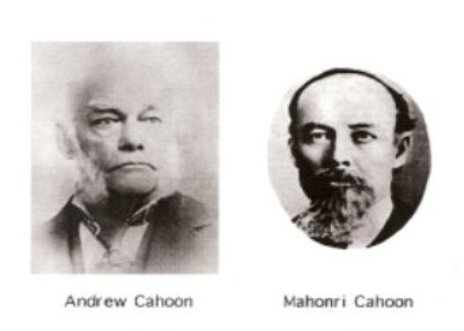
Sometimes history can present an intractable situation, such as the case involving our Cajon Pass. It all started from the passage from a book entitled "The Carruth Family", which was written by H.B. Carruth and published by Higginson Publishing Company in 1953. On page 227 of the family manuscript was an amazing claim-the Cajon Pass may not be the Cajon Pass at all! The book introduced Mormon bothers Andrew and Mahonri Cahooh, both were early pioneers of the San Bernardino area and Andrew's name graces the Pioneer Memorial at the present day Route 66 and the 115 north freeway, right in Cajon Pass. Both brothers were influential in the San Bernardino area, both were present when the Mormon church purchased the great Lugo Ranch, whose boundaries also reached Cajon Pass. Andrew Cahoon was credited to having assisted in the survey the San Bernardino valley and helping in laying out the city of San Bernardino itself. They were definitely colonizers, settlers and pioneers in our area's early history. And, boy howdy! Cahoon sure did sound a lot like "Cajon", or vise versa. But, for over two hundred and thirty years, one of the gateways to Southern California, the area just outside of Wrightwood, Ca., has been called the Cajon Pass. What a quagmire! Did a wrong footmark in history produce the wrong name for the famous exit of the Old Spanish Trail?
According to a paper entitled "Cajon Pass or Cahoon Pass", the Carruth manuscript spelled out some convincing arguments that suggested that Cajon Pass could have actually been "Cahoon" Pass:
April 15, 1850-"Elder Pratt speaks of finding gold, then asks: '...and we came to Cahoon Pass.'"
November 20, 1850-"Brigham Young in a letter to Dr. Bernhisel, says of Iron County...'There is no other feasible route to California from that place than through Cahoon Pass.'"
December 4, 1850- Mormon General Assembly: "Be it ordained by the General Assembly...as soon as practicable, continuously to intersect a stage route from Cahoon Pass."
April 7, 1851-"A. M. Lyman and C. E. Rich are en route to the Cahoon Pass."
April 21, 1852- "The Deseret News (Salt Lake, Ut. newspaper) prints: 'Elder Rich arrived Wednesday, April 21, in the company of 13 others, among them were two brothers Cahoon, direct from San Bernardino to the Cahoon Pass where the brothers are settled.'"
December 12, 1857-"A statement of Wm. Hall reads, 'We came up to the mouth of the Cahoon Pass.'"
December 23, 1857-"A letter from President Pratt (Mormon Church) and Benton mentions, 'That in passing the Cahoon Pass, Sierra Nevada Mountains.'"
In continued research I finally got a clue that perhaps Cahoon Pass was somewhere else, like in the Sierra Nevada Mountains, which was certainly a long ways from present day San Gabriel Mountains, where the "Cajon Pass" is. Then, I was thrown for a loop...when I read a chapter from John W. Robinson's extensive historical account "Gateways to Southern California", a book well worth the read and published by The Santa Ana Historical Society, 2005). On page 200, "A vivid description of crossing the pass southwards into West Cajon Canyon (a canyon within the present day Cajon Pass) was given by S. N. Carvalho, an adventuresome artist who was traveling from Salt Lake to Los Angeles in June 1853: "At noon we arrived at the summit of the Cajon Pass in the Sierra Nevada...". So, was Cahoon Pass in the Sierra Nevada...or was Cajon Pass? Was Cajon Pass in our area...or was Cahoon Pass? The quagmire of Cajon Pass deepened, as did my puzzlement.
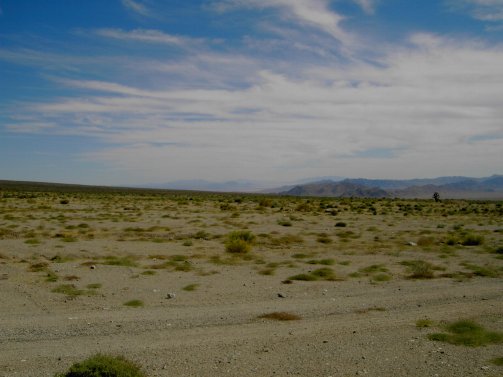
The Bitter Springs area, Mojave Desert
Without going into great detail of the Mormon trek, which has already been well documented in history, the journey was interesting. The first Mormon group to come up the Spanish Trail and subsequently blaze their way through present day Cajon Pass, was the Mormon Battalion. Even though the first settlers of this area, The Swarthouts, were with the military group, Andrew and Mahonri Cahoon were not. The Mormon Battalion traveled through the extreme southwest route coming to southern California, passing through areas whose names are recognized to this day: For instance- Mojave, Salt Springs and Bitter Springs (near present day Ft. Irwin). These same locations were given in diary accounts by other Mormon individuals , one in particular was named James Rollins, who made the trip into southern California at the same time the Cahoon Brothers did. There was no location on the desert route called "Cahoon Pass"....the only things similar to that name was "Cajon Pass", which sounded like "Cahoon". Perhaps the Carruth manuscript had a point.
According to "A Century of Mormon Activities in California", written by Muir, this interesting tidbit was mentioned; "In the early records of the L.D.S. Church Journal History (1850-1872), the "Cajon Pass" is referred to as "Cahoon Pass", or the Scottish name meaning a "Narrow Wood" or "Sea Coasting Common or Point" to which a description of the land conform. "Cajon", the Spanish spelling, is pronounced Cahoon, and means "box". However, the true origin of the name of the pass has not yet been established, although there is a strong inference that it was named after the Cahoon Brothers."
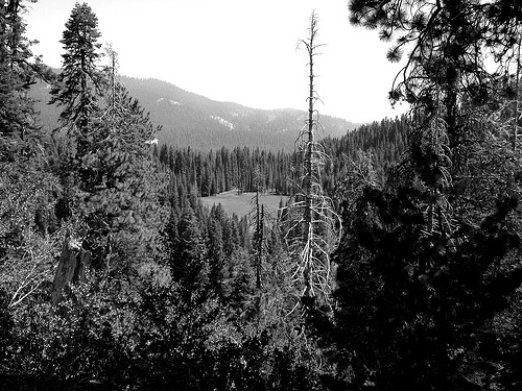
Cahoon Meadow looking toward Cahoon Pass, now referred to Cahoon Gap. "Cahoon" means "Narrow Wood".


