Author Topic: Federal researchers - Embers were a leading cause of destruction  (Read 27671 times)

0 Members and 1 Guest are viewing this topic.

Offline Wrightwood

  • Administrator
  • Raccoon
  • *****
  • Posts: Plenty of Posts!
  • Wildlife Gateway
Small spark can mean disaster for home
A wind-blown ember can be opportunistic, slipping through breaches in a structure.
By Tony Barboza, Tami Abdollah and Joe Mozingo

November 18, 2008

The Haroutounians set off for their home on Big Horn Mountain Way confident it had survived the firestorm.

They had a barrel tile roof, boxed eaves, brick and stucco siding. They had just cut down three trees near their house and cleaned out the rain gutters. And a wide street and a line of other large luxury homes separated their Yorba Linda property from the brush wild lands of Chino Hills State Park.

But their hearts sank when they turned onto their block Sunday afternoon. Of the 18 homes on their side of the street, only two had burned. One was theirs.

"I'm glad that my neighbors' houses survived," said Hamlet Haroutounian, 47.

"But it bothers me: Why my house?"

The answer was something they never thought of: the humble attic vent.

"An ember settled right there and got into the insulation," said Capt. Bill Lockhart of the Orange County Fire Authority, pointing to the gable vent on a still-standing wall. "I can guarantee it. It's almost out of a textbook."

He said the mesh covering the vent had quarter-inch holes. Fire marshals now recommend eighth-inch mesh.
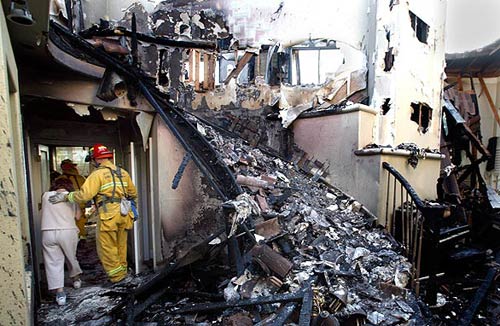

Mark Boster / Los Angeles Times
An Anaheim Fire Department captain leads Hanna Haroutounian out of her burned home.

For 50 years, fire authorities have told homeowners in fire-prone areas to get rid of shake roofs and to clear brush, and people have gradually heeded the advice.

These days, the devil is hidden in the smallest of details.

"There will be a weak link in the house that is destroyed," said Stephen Quarles, an advisor at UC Cooperative Extension and an expert in how homes catch fire.

He said it is usually not raging flames that ignite a home, but an ember slipping through a small breach: a vent, a doggie door, a gap under the garage door, an open window, a cracked roof tile.

Fires like the one that raged through north Orange County last weekend, destroying 113 homes in Yorba Linda, spew billions of embers into the air -- some as small as an apple seed. Santa Ana winds drive those burning projectiles horizontally for hundreds of yards, pelting homes far from the flame front. Just one ember getting through a crack could spell destruction.

"The biggest thing that causes these homes to burn is ember intrusion," said Chip Prather, chief of the Orange County Fire Authority. "You've got hurricane-force winds pushing embers toward houses."

The goal is to seal off the home like a ship to the sea and prepare for a leak where it is most likely to occur.

People don't think of the newspapers awaiting recycling in their garage, or old boxes in the attic, or dried-up birds' nests in the arches of roof tiles.

State rules in effect since July 1 are meant to address this. Builders in fire-prone areas are required to screen attic vents, cover eaves, use non-flammable planks for decks, install tempered glass in windows so they don't shatter when heated and close the gaps under barrel tiles with mortar or a piece of material called a bird stop.

The rules do not require homeowners to update existing homes. And even compliance with the new code doesn't guarantee safety.

Wood mulch, patio furniture and trash cans ignite next to the house. Wind pushes piles of burning debris against doorjambs.

Ornamental plants catch fire, and then crack a window or send a flume of embers into an attic vent. Even lush, well-watered foliage dries up in the searing wind and becomes a fire hazard.

In an analysis of last year's Witch fire in San Diego, federal researchers determined that embers were a leading cause of destruction.

Of 74 homes that burned in the Trails neighborhood of Rancho Bernardo, only 19 were next to the flaming front of the wildfire.

Embers destroyed the rest -- either by starting a spot fire next to the homes (in at least 35 cases) or by directly entering the home (in at least 20 cases), according to the Building and Fire Research Laboratory of the National Institute of Standards.

The study confirms what firefighters have been seeing for years.

Michael Boyle, a battalion chief with the Orange County Fire Authority, came upon a Yorba Linda resident who had stayed Saturday to defend his home. Boyle saw wood patio furniture scattered about the backyard.

"I told him to throw it in the swimming pool, and he did," he said. "A few hours later the house was still standing."

Boyle and other firefighters pointed to another culprit: palm trees.

With their lattice of dead and dry material, they light up instantly and unleash blazing debris like an arc welder.

"Many times I saw people wetting down their roofs," Boyle said. "Don't waste your time on the roofs; point your hose at the palm fronds over there."

One firefighter said he spent the good part of a day pulling fallen, burning palm fronds away from garage doors.

On Ridge Park Drive in Yorba Linda, Michael Landig watched palm trees carry the fire from property to property.

"The neighbors' palm trees were just exploding," he said, "and we were running and getting ladders and getting hoses and putting out the palm trees. That was the first thing that caught in every instance."

He watched the paint on the house next door start bubbling. Soon the glass windows exploded and the home burst into flames.

When one home goes down, its neighbors' are much more likely to burn, too. While wildfires roar through in minutes, a house fire can last for an hour, radiating enough heat to ignite curtains and blinds through the windows of the homes next door.

Fortunately, Landig's home survived.

Hamlet Haroutounian acknowledged the fire captain's explanation of why his home burned. The exterior walls of the home were still standing, but the inside was destroyed, clearly from the attic down.

"It's hard to accept," he said.

The homes on Big Horn Mountain Way were all built in the early 1990s to the same standards. Of 35 homes on the street, 27 remain standing. And 11 of those are, unlike his property, right against the wild land.

But at least one of Haroutounian's neighbors had taken extraordinary precautions.

When the fire roared up to Michael Bishop's house, his girlfriend flipped a switch and nozzles began spraying Phos-Chek fire retardant all over the side of his house, coating even his plants.

Bishop, a 50-year-old emergency room doctor, installed the system for $15,000, which can be activated by phone if no one is home to turn it on.

"We're very conscious of the fact that there's a fire risk here," he said. "All it takes is one ember."

Barboza, Abdollah and Mozingo are Times staff writers.

tony.barboza@latimes.com
tami.abdollah@latimes.com
joe.mozingo@latimes.com

http://www.latimes.com/news/la-me-firewhy18-2008nov18,0,7203016.story?page=2&track=ntothtml
From the Los Angeles Times
Wrightwood Forum is the first & most dependable local social media outlet

Offline Wrightwood

  • Administrator
  • Raccoon
  • *****
  • Posts: Plenty of Posts!
  • Wildlife Gateway

Offline Wrightwood

  • Administrator
  • Raccoon
  • *****
  • Posts: Plenty of Posts!
  • Wildlife Gateway
Wind-blown embers, which can travel one mile or more, were the biggest threat to homes in the Witch Creek Wildfire. There were few, if any, reports of homes burned as a result of direct contact with flames.

BASIC FACTORS AFFECTING WILDFIRE RISKS TO BUILDINGS

Any pathway that will allow burning
embers to get inside the house: This can include vents (sofits, attics, crawl spaces or wall vents) or windows prone to breaking when exposed to wildfire conditions
(usually unprotected, single-pane windows).

Fuel sources within 30 feet of the house that will support a high intensity spot fire: This can include any trees that can quickly become a fire torch, such as a palm tree with a beard, a wooden trellis made of common lumber sizes, playground equipment made with wooden pieces or a pile or rack of firewood on the ground or in a wheelbarrow.


http://www.disastersafety.org/resource/resmgr/pdfs/wf_research.pdf

Offline SkierBob

  • Raccoon
  • *****
  • Posts: 1894
  • Hangin' out Down the street
I would expect WW to run out of water pretty quick in the event of a fire storm.  I'd think you can pretty much count on not having any water. 

Calindy

  • Guest
Someone told me that some houses were sprayed with that fire retardant prior to evacuating and their houses were saved. Anyone have that info as FACT?

Offline SkierBob

  • Raccoon
  • *****
  • Posts: 1894
  • Hangin' out Down the street
Someone told me that some houses were sprayed with that fire retardant prior to evacuating and their houses were saved. Anyone have that info as FACT?

Good question!  I find it hard to believe anything could survive the recent firestorms.   


Offline james6000

  • Scrub Jay
  • ***
  • Posts: 121
  • Waiting for winter....
Would it help to cover the windows and attic vent with plywood?

Offline Wrightwood

  • Administrator
  • Raccoon
  • *****
  • Posts: Plenty of Posts!
  • Wildlife Gateway
Yes that might work in some instances but remember, if you create new voids over 1/8", where the plywood does not lay flat, embers could intrude and make matters worse. 

Offline Elk

  • Moderator
  • Raccoon
  • *****
  • Posts: 1561
  • Go PATS!
Quote from: Calindy on Today at 10:57:12 AM
Someone told me that some houses were sprayed with that fire retardant prior to evacuating and their houses were saved. Anyone have that info as FACT?

Good question!  I find it hard to believe anything could survive the recent firestorms.   

Yes there is a story of a guy in Yorba Linda who had a foscheck (sp?) fire retardant system installed on his home. I heard about it on KFI first and then saw a story on Channel 9 KCAL news at 2:00 today.

From what I understand he invested 15k for the system which sprays the exterior of the house and surrounding yard with the retardant. The system is even capable of being turned on remotely via phone line or internet. So if you are at work or out of town the system can be activated.

They interviewed the owner who is a doctor and while he is not sure if the system actually prevented the fire from taking his house but he is very happy that his house is still standing. The owner was even commenting that all his neighbors had damage to their landscaping in some form. Burnt trees and shrubs etc., but this guys yard was untouched due to the fact that the system sprays out from the house as well as covering the house itself. The owners quote was something like "not even a flower was harmed in my yard".

Sounds like forethought and a little cash went along way for this guy!

Offline BikingBrian

  • Bear
  • ****
  • Posts: 447
Since I have excellent attic and crawl space access, it would seem like a no-brainer for me to buy 1/8" mesh and cover the vents from the inside - even if it means putting on top of the old stuff.  Are there any websites or other sources that advise this?

Offline Elk

  • Moderator
  • Raccoon
  • *****
  • Posts: 1561
  • Go PATS!
Re: Federal researchers - Embers were a leading cause of destruction
« Reply #10 on: Nov 18, 08, 06:53:00 PM »
Since I have excellent attic and crawl space access, it would seem like a no-brainer for me to buy 1/8" mesh and cover the vents from the inside - even if it means putting on top of the old stuff.  Are there any websites or other sources that advise this?

That is what I intend to do. Where I cannot get to the inside to cover the vents I intend on cutting the mesh to fit and tying it into the existing mesh.

Those with raised foundation should also cover the crawl space vents in addition to the attic vents.

My only concern is that over time the mesh will collect dust and other debris and then will not vent air as designed to do so when it is warm or moist. Just another thing to add to the "To Do List" when maintaining any home.

valeraxy

  • Guest
Re: Federal researchers - Embers were a leading cause of destruction
« Reply #11 on: Nov 18, 08, 07:59:11 PM »
My only concern is that over time the mesh will collect dust and other debris and then will not vent air as designed to do so when it is warm or moist.

Since we're doing some work on the attic right now (adding insulation) I was thinking about this. Does it get moist enough in WW that we actually need vents? It seems most of the time the humidity is around 30%. Does anyone have experience with unvented attics? Would soffit venting be enough?

Offline Elk

  • Moderator
  • Raccoon
  • *****
  • Posts: 1561
  • Go PATS!
Re: Federal researchers - Embers were a leading cause of destruction
« Reply #12 on: Nov 19, 08, 07:36:56 AM »
Someone told me that some houses were sprayed with that fire retardant prior to evacuating and their houses were saved. Anyone have that info as FACT?

CBS/KCAL sent me this link to the retardant system featured on yesterday's newscast. Here you go!
http://www.cbs2.com/video/?id=83706@kcbs.dayport.com

Calindy

  • Guest
Re: Federal researchers - Embers were a leading cause of destruction
« Reply #13 on: Nov 19, 08, 09:54:07 AM »
Thanks Elk!

Offline SkierBob

  • Raccoon
  • *****
  • Posts: 1894
  • Hangin' out Down the street
Re: Federal researchers - Embers were a leading cause of destruction
« Reply #14 on: Nov 19, 08, 10:22:39 AM »
Since we're doing some work on the attic right now (adding insulation) I was thinking about this. Does it get moist enough in WW that we actually need vents? It seems most of the time the humidity is around 30%. Does anyone have experience with unvented attics? Would soffit venting be enough?

I had always thought vents were to cool the attic during summer months.  I have two vents both are on the wall at the roof peak.  I did not put any vent penetrations through my roof as I see it as more of a fire hazard then a cooling benefit. I installed up ducts so my swamp cooler pushes cool air through the house then into the attic via the up ducts.. 

Moisture hasn't been a problem yet..

Offline Wrightwood

  • Administrator
  • Raccoon
  • *****
  • Posts: Plenty of Posts!
  • Wildlife Gateway
Re: Federal researchers - Embers were a leading cause of destruction
« Reply #15 on: Nov 21, 08, 09:49:05 AM »

Embers fly as wildfires burn near Carbon Canyon park in Brea, California November 16, 2008. Wildfires hop-scotched around Southern California on Sunday although calmer winds slowed flames that have destroyed almost 1,000 houses, forced tens of thousands to evacuate and turned some neighborhoods into scenes resembling war zones. (REUTERS/Mario Anzuoni)


An unidentified woman evacuates her home as embers blow around her during a wind driven brush fire in northern Los Angeles on Friday, Nov. 14, 2008. (AP Photo/Dan Steinberg)


More: http://www.boston.com/bigpicture/2008/11/california_wildfires_yet_again.html

Tumblebush

  • Guest
Re: Federal researchers - Embers were a leading cause of destruction
« Reply #16 on: Nov 21, 08, 07:42:22 PM »
I've heard of houses burning down from just having the fire heat the glass on the windows enough to catch the curtains on fire. Ever since then...when there is a fire in the area, I always take my curtains down for a while. Figure it's a good time to get them cleaned.

Nightowl

  • Guest
Re: Federal researchers - Embers were a leading cause of destruction
« Reply #17 on: Dec 05, 08, 10:39:26 PM »
From someone who has lost their home in a fire with strong winds,  the best thing you can do besides creating a defensible space is, if you have the yard space, install a 5000 gallon water tank (anchored for earthquakes), gas operated water pump and several hundred feet of hose.  Count on the fire dept not being available to help you and the fire hydrants to have little or no pressure.