Author Topic: HF Talk  (Read 27955 times)

0 Members and 2 Guests are viewing this topic.

Offline Toolman

  • Raccoon
  • *****
  • Posts: 874
  • You can't fix stupid
HF Talk
« on: Feb 07, 09, 03:24:27 AM »
 Since we don't have a topic for HF discussions, I thought it would be fun for those of us and pending upgrader's, and those who are active in the many HF activities that could be discussed. Sharing your first HF contact after upgrading, what modes you like to opporate, QRP, CW, RTTY, SSB, HI-FI SSB etc. and contesting, special event stations. I have grown to like special event stations because they usually have a meaning. Several are history related or are involved with a school activity.
Making contact with the space shuttle for the El Segundo High School took a lot of preperation and a team to set up the station and az-el beams. It was worth every effort....

 What operating station you currently have, antenna's and ideas for upgrading, what your'e operating and discussing what would work for the space you have to erect an antenna for HF.
 HF communications is just as important as UHF and VHF since the Red Cross sets up a complete HF station when on site.

 To bring it short, I got involved with Ham radio for several reasons. Emergency radio needs and my all time favorite making DX contacts and simple rag chews with another Ham across the country or continent.

 The band conditions are in the upswing cycle and if you're planing to upgrade, now is the time.

 With no code required for HF opperating, now is the time to give it a thought about making contacts all over the world.

 When I first got licensed as a no-code tech I couldn't stop there becasue my goal was to work HF and make those world wide contacts. After no-code tech was tech + which required 5wpm code. Then on to General which required 13wpm code. Then the oh-my gosh look at this book....Advanced Class which took three month's to study and no extra code....thank you. Then there was the Extra class that required the practical exam and then 20wpm code. What helped me through the process in less than a year was determination and getting on the air and operating the modes that were in the study guides. Being a VE and then a VEC, and at the time satalite operator which many questions about that are on the Extra test, the practical test was a snap. I don't oporate CW or the sat's much anymore but I've tested myself and the speed is still around 15 wpm.

 I have WAS in single multiple bands (10-15-20) I have to check but I'm not sure if the WARC bands are included, and I am currently working on 40 mtrs. and not far from DXCC. One card you cannot get now days is Sri-Lanka and I have one contact from there.

 I reccommend that you join the section 6 bureu for QSL cards. You simply sign up and send a check to cover postage and handling. Why, because most continental Ham's use the buero rather go direct and many of them have QSL managers who you send your cards to.

 Those of us who work HF and have experience in this already is aware, but those considering  working HF May not.

 I'll never forget my first HF contact with Miguel from Spain on 20 mtrs. which I happen to make contact again last night on 40 mtr.s no less.

 This is what led me to start this post, for people to discuss antenna possibilties who want to upgrade and radios. Also to share a memorable HF contact.

73,
WB6K

Offline Toolman

  • Raccoon
  • *****
  • Posts: 874
  • You can't fix stupid
Re: HF Talk
« Reply #1 on: Feb 07, 09, 05:08:08 AM »
 To not make the last post boring I thought I'd share my favorite HF bands for continental and US contacts.

  While band conditions conitnue to become better, my favorite band is 20mtrs. While battling a DX pile up, I met Bing Crosby's nephew many years a go who lives in Spokane Wa. We eventually had a regular sched at 18:00 every night on 14.155 and became good friends. He actually drove to Idaho and found my old house in Hayden Lake and sent back pictures.... very memorable. I use 20 mtrs. for most of my DX chasing. When the conditions are good, contacts into Europe in the late evenings are good as the sun rises. I like 15 mtrs. from 16:00 - 18:00 for Asia and the pacific rim and into Russia as the sun rises their next morning. After 18:00 hrs. DX can be had on 40 mtrs. as well as stateside contacts during the day. When 40 mtrs. dropped off tonight, 80 mtrs. was very active with contacts to the east coast.

 DX summit is a good place to look at sunspot activity and postings of DX activity. I've been an active member of the DX club 2mtr. repeater on Mt. Lukens for many years and the repeater announces DX activity.

 Another favorite band is 17 mtrs. and am looking forward to getting my three element Yagi up soon. It has about the same propogation as 20 and holds in longer than 15 mtrs. but the band is short in operating width. Another new antenna going up on the tower is the Cushcraft D40 rotatable dipole that is 42' in length and will be mounted at 75 feet. Below that is the 17 meter yagi at 62' and below that is the KLM KT-34 at 55 feet.

 The second tower is the VHF UHF station, 6mtrs-440.

 So many antenna options to consider for HF work. Verticles with a good ground plane have excellent results and don't take up much space. Wire antenna's if you have room for half havelength on the chosen band. G5RV's are a good option for limited space but tend to create harmonic's fed with ladder line. Loop antennas at 40-50 feet above ground at 300+ feet in length in the trees work well with a 4-1 balun which is what I use in Wrightwood and almost invisible.  ;D  What I like about the loop is that it hear's very well, horizontally polarized and is omni directional and I can carry on a conversation with multiple stations in Alaska to Florida. Good verticles like a Gap or Hy-Gain DX-40 will do the same if your location suits the installtion. It helps to be in a higher elevation such as W-W and not alot of city noise and we have a good take off to the east and north.


 At the other QTH, the set up is not quite as invisable with two towers and multiple Yagi's, but it's very efficient. I like Yagi's for their directional pattern and low noise in the city. Toss a KW in one direction, well almost, and your going to be heard. I was working a station in eastern Canada once and a call came in from Austrailia who couldn't hear the Quebec station but hear'd me on my back side. It's a lot of hard work and heavy equipment to impliment a tower set up but well worth it if yout up to it.

Happy Dx'g
WB6K


Offline Toolman

  • Raccoon
  • *****
  • Posts: 874
  • You can't fix stupid
Re: HF Talk
« Reply #2 on: Feb 09, 09, 04:11:46 AM »
 I spent a short time (about an hour) on 20mtrs. tonight before our 2mtr. net and had easy contacts (3) into Mexico, several into So. America, HI, AR. Ut. Al. and Nm. Since several contacts into Hi. were made after sunset, (it was 82 F there) that confirms my anticipation of increasing activity into the evening hrs. Once 15 mtrs. becomes active again after sunset in Ca. into Asia Continents, which I am predicting by this summer, the low bands will be worth those thinking of advancing to General.   When 15 and 17 is active, 20 is usually booming with activity.

 As mentioned before, I made contact the other night into Spain on 40 mtrs. only running 100 watts which I consider QRP.  ;D

 Band conditons after sunset are getting better  ;)

To keep up on conditions and postings of DX contacts I go the DX Summit web site. I've never personaly posted, but others have posted my activity which caused pile-up's calling me that kept me glued to the chair for hours answering calls. Working many years of contesting helped get through the pile-up's expeditiously. It's great fun the first time you've created your first DX pile-up..... but it's also work and it's hard to walk away from it.

http://www.dxsummit.fi/DxSpots.aspx

 If you get heavily active on HF, be prepared to have QSL cards made ( I make my own) it would be wise to join the 6 district QSL manager. They take care of everything.... just send $$ for postage. They arrive in the mail in bulk envelopes.

 Any one else working HF into the wee hours? I'm curious how the bands are around midnight when Europe is waking up?

_ _ ...  ..._ _
WB6K

Offline Wrightwood

  • Administrator
  • Raccoon
  • *****
  • Posts: Plenty of Posts!
  • Wildlife Gateway
Re: HF Talk
« Reply #3 on: Feb 09, 09, 04:23:13 AM »
Thanks Toolman for the inspiration as I had my HF on yesterday and today.

How about a Q&A session on the weekly Net about HF ?

Offline ak7v

  • Squirrel
  • **
  • Posts: 74
Re: HF Talk
« Reply #4 on: Feb 09, 09, 04:03:25 PM »
Toolman,

Thanks for the great background! 

Most of my ham radio activity has been on HF.  Like you, I started as a no-code-tech.  After about a year on the repeaters, I began studying Morse Code and the General class theory.  I went to the testing location in Northridge, CA to take the General theory and to try the 13WPM code (I knew I'd pass 5WPM, but I figured I'd go for the General upgrade).  Luckily, I passed both and left a General that day.  I got on the air every night with my borrowed Heathkit SB-102 and 40m dipole on my parents' roof and operated CW exclusively (my elmer didn't give me a mic for the radio).  After a month of operating and studying, I decided to go back in for another round of tests.  I was confident on the Advanced theory, figured I'd give the 20WPM a shot while I was there, and didn't feel prepared for the Extra theory.  Well, somehow I managed to pass all of them and ended up an Extra that afternoon.

I really enjoyed CW and did all my HF operating in that mode.  Some of my most memorable DX contacts on 40 meters with that SB-102 were with Antarctica, Senegal, Australia, and Spain. 

Then I left home for college and didn't do any operating for several years.  After graduating, I moved to Seattle and bought an Elecraft K1 kit to get me back on the air.  I put it together (it was a 5-7 watt CW only radio, powered by batteries) and threw a wire antenna out my apartment window.  I was regularly making contacts with Japan, New Zealand, and all over the western US on 20 and 30 meters running only 5 watts into an extremely poor antenna.  Quite a rush!  I took my radio out to the mountains, threw my wire antennas into the trees, and operated in contests from the great outdoors.  My CW speed increased to about 30WPM for ragchews and 40+ for contest exchanges.  I also briefly worked on building my CW speed using RufzXP software - freely available on the net.  I highly recommend it for building callsign-copying speed.  It's frustrating as heck, but it works.

I went off the air again for a couple years due to work/family obligations.  Sold the Elecraft (which I regret).  Now I have an Icom IC-703, another low-power radio capable of running on batteries, and am looking forward to stringing up an antenna at my new Wrightwood home.  My intention is to put up a 130' doublet center-fed with ladder line.  I'll probably be on 20, 30, and 40 meters most of the time, and usually on CW.

I second Toolman's recommendation to upgrade ASAP if you've been thinking about it.  I have never been active during a solar peak and am really looking forward to the upcoming one.  Bands like 10, 12, and 15 meters should really come alive and allow easy worldwide contacts with modest antennas and power levels.  And definitely sign up with your QSL bureau - especially if you make a lot of contacts with Japan.  Most Japanese ops I've worked send QSL cards.  I really enjoy flipping through my QSL collection and remembering all those "unlikely" contacts using only 5 watts and a chunk of wire from an apartment window.

73/72,
ak7v

(72 is the QRPer's version of 73.  QRP ops use 5 watts or less to make contacts)

Offline Toolman

  • Raccoon
  • *****
  • Posts: 874
  • You can't fix stupid
Re: HF Talk
« Reply #5 on: Feb 09, 09, 11:40:57 PM »
Jason (AK7V)
Thanks for sharing your history and contributing to HF talk.

 I just came in after tossing snow all day (twice) and hopped on 20mtrs. for a bit and worked a few Victor Echo stations in Canada, Austria, and a bunch of stateside rag chews. My rig up here is QRP also....ok well it is for me at 100 watts. ;D use to running a tad more than 100  ::)

 Since your thinking of a wire for up here, give a loop some consideration. I'm a big Yagi fan but I had been on the receiving end of Loops before and decided to give it a try. Mine is 300 + feet strung through the trees at about 40-50 feet into a Centaure 4.1 balun and about 50' of RG-213 to the Kenwood TS850. I use no other tuner other than the internal tuner an it works from 10-80 no problem. Worked 80 the other night into the east coast. Low noise on the lower bands (40-80) with the loop horizontal.

 Tired and getting a quick recharge nap and going to hit the low bands again.  ;)

73,
WB6K

Offline ak7v

  • Squirrel
  • **
  • Posts: 74
Re: HF Talk
« Reply #6 on: Feb 10, 09, 03:58:43 PM »
I threw about 30 feet of wire into a tree outside my house last night and laid another 20 or so feet along the ground as a sort of counterpoise -- a quick and dirty set up that I do when I don't feel like playing with the slingshot and pulleys.  I run those into a 4:1 current balun and then to the built in ATU on the Icom, which works surprisingly well.  I called CQ at 10 watts for a while on 40, 30 and 20 meters at around 8:30PM but had no takers.  I heard a couple stations in Texas, California, and one in Oregon.  I wonder whether Wrightwood's topography, being in a canyon essentially, makes it tough for signals to make it in and out?  I may need to upgrade to a 100 watt radio at some point. :)

I'm really looking forward to putting a "real" wire antenna up.  A loop is definitely something I'm considering, too.  I don't have a ton of trees on my property, but part of the fun of wire antennas is experimenting and figuring out what will work.  Probably once some of this snow disappears I'll make an effort to put something up higher.

Offline Toolman

  • Raccoon
  • *****
  • Posts: 874
  • You can't fix stupid
Re: HF Talk
« Reply #7 on: Feb 11, 09, 05:54:24 AM »
I love your tenacity to get on the air so soon and the sling shot pully tactic...what... no fishing pole ;D

 On the right track with the 4-1 balun and not using ladder line....that stuff resonates like crazy. If you can get at least 300' of wire in a semi - circular or even rectangle configuration 40' above ground, that baby will work  :thumbs:  Contact the forum adminstrator for a tree climber to do the install. ;)

 I've stated before of my dislike of verticals for the noise but when installed properly they do work well. It may be a solution for your space constraints. Gap and Butternut make excellent verticals as long as you triple up on the ground radials.

 Got off the mountain today  :'( to justify my existance to society... ::)

 My three element 12-17 mtr beam is assembled and taking up the entire back yard. The 40 mtr D-40 is in two pieces (21' each) hanging from the rafters in the garage. The KLM KT34 10-20 beam is laying in pieces on the roof of the house. Yea...sick eh'  ;D The tower is cranked down and ready to fold over to install the Yaesu G1000 rotor but this weekend forcast is not looking good for the transfer. The new rotor cable and connectors will be assembled this week. I'm trying to capture photo's but sometimes I get ahead with the work and no pics taken.

 VHF and UHF tower two re-configuration will follow.

 100 watts eh'.... thinking of moving to the "other side"  ::)

 In LA LA land for now and no HF for a few more weeks... :'(

good luck

Offline Toolman

  • Raccoon
  • *****
  • Posts: 874
  • You can't fix stupid
Re: HF Talk
« Reply #8 on: Feb 21, 09, 05:11:05 PM »
Howdy,
 I've completed the re-assignment of antenna's on tower one this week. It's a 55' three section fully supported crank up tower installed originally in 1996. The concrete base is 4'x4'x6' deep and has a rebar support cage supplied specifically to support the tower.

  I originally installed the KLM KT-34 at 55' and two large M2 2 mtr. beams at 65 and 70 feet. I use to do a lot of sat operation and SSB work on 2mtrs. and 440 with a Kenwood TS-790. I fell out of VHF SSB operation and concentrated working HF with the KLM for many years. I constructed many I-V dipoles over the years with some what decent success but you just can't beat a Yagi for performance. When the rotor finally died and locked up I decided to set up this tower for HF work only.

Antennas:
 Retaining the KLM KT-34 which is an excellent yagi with a 3" dia. boom at 16 feet long and four elements no trap design for 10-15 and 20 mtrs. Gain is about 7dbd. if I remember correctly and weight is approx. 65lbs. longest element (reflector) is 28'. Installation height is 55'.
 The second beam of choice is a Cushcraft A3WS Warc Band beam with a 14' boom and three fullsize elements for 17 mtrs. and traps for 12 mtrs. gain is about 6dbd. and weight is 22 lbs. longest element (reflector) is 25'. Installation height is 62'.
 The third antenna is a Cushcraft D-40 halfwave rotatable dipole for 40 mtrs. weight is 22lbs. total length is 43' and is mounted at the top 70'.

 The tricky part is rotating the yagis 90 degrees while the tower is on the ground due to the long elements to get the D-40 mounted pointing the same direction as the yagis. :-\ multiple 8' ladders are a must.

 While the tower was folded over I inspected it for signs of fatigue and cable condition. Other than some very lite surface rust it was in very good condition. I spent a couple days wire brushing some surface rust areas and applied Rust-Oleum Cold Galvanize paint. The stuff is great for outdoor use and is Zinc based. The mast got the same treatment and is 2" od x .188 wall chromoly tubing.

 The new rotor is a Yaesu G-1000 replacing the old Hi-Gain Ham IV. I'm so far very pleased with the rotor and it has a very nice controller with user pre-sets for favorite operating azimuth settings. The rotor cable is the beldon heavy gauge wire 16-18.

 Here's a few pictures along the way of the two weeks the tower was on the ground. I was able to build a new tower fold over fixture since e had a failure with the first one.... not a good feeling. The new one is bomb proof.  ;)

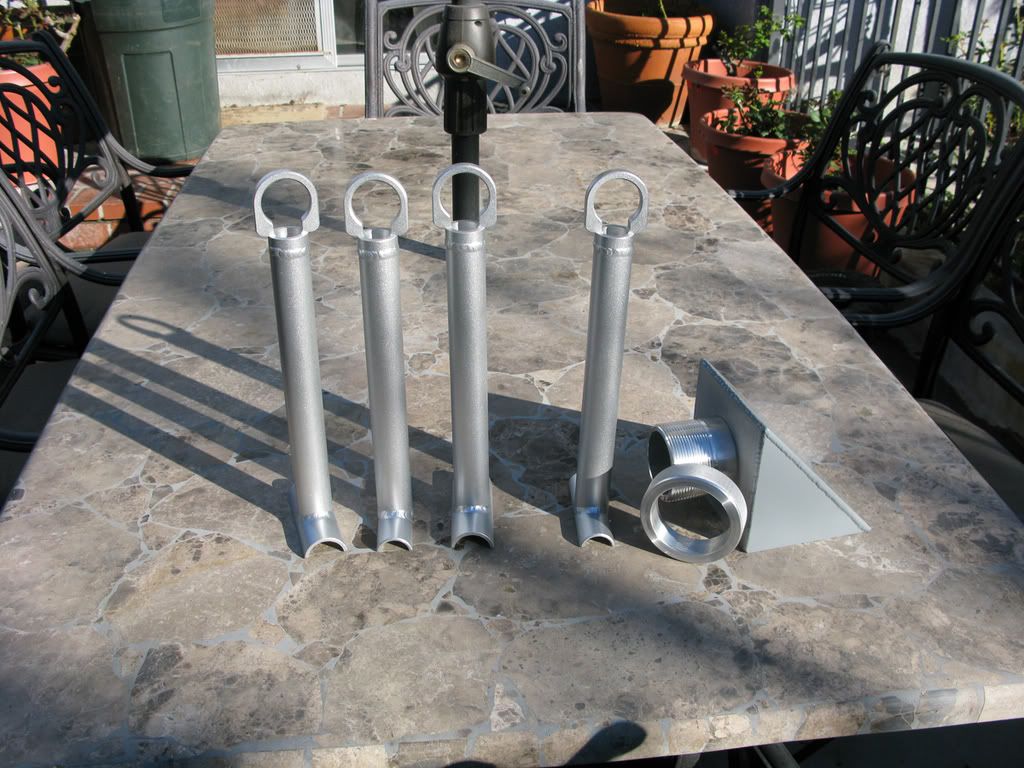
 I machined new coax-cable stand-off attachments and machined a weather box for running coax-rotor cable into the garage. They got powder coat treatment and should hold up well.

 Here is the tower cranked down from full length and ready to get worked on.


 My buddy Paul and I are removing the elements from the KLM yagi and will be laid out on the roof in order as they come off. I can't lower the tower from vertical to horizontal with the elements attached. You can see how large the 2mtr. beams are. I worked many stations on 2mtr. SSB with those beams. Even into Nevada and Arizona during  VHF-UHF contests.


 This is the view from the roof looking down into the patio. You can see how large the 17-12 mtr. yagi is laying on the saw-horses.


 This is the tower being lowered to the ground with a rope attached to the KLM boom. We had to lossen the mast from the rotor to rotate it because the rotor was stuck.


 Here's the tower lowered over and being supported by both the cable and the ladder. It's ready to get the week long make-over.
 

 This is what the new fold over attachment looks like. You can't see from the photo, but there is a winch mounted on the side of it hidden by the tower. We operate both winches simultainiously to clear the house and fence.


 There is a ton of other photo's showing work being done, attaching yagi's etc. but I'm trying to make this a short version ;D
 This is me cranking up the tower to vertical and we'll bolt it in place and plumb it. It's secured by 6 3/4" bolts to the base and is freshly painted stem to stern. We're far from on the air yet though. Coax needs to get straightened out and run into the garage. Coax needs to be cut to length and ends soldered on them.


 Darkness settled in quickly after getting the tower up and coax straightened out. This picture is the next morning at full height above ground and it's time to work on the coax and hook it all up and test SWR. This is in the backyard looking up, the view for blocks is HAM fever.  ;D


 All the SWR checks went well and no tuning to the antennas were required... because I followed the assembly instructions. ::) After shortening coax and soldering the connectors it was time to get on the air.... woo-hooo. Made many contacts State-side on 40mtrs. couldn't believe how quiet that 40 mtr. dipole is compared to what I was using. I thought something was wrong until I heard 20 over 9 signals from the right coast. Made a few contacts, signal reports on 17mtrs. with 20 over 9 signal reports. Made some 20mtr. contacts into Canada and a bunch in the US...nothing to jump about. Conditions weren't open into Europe. It's nice to hear signals and low noise levels with these Yagis. After a few contacts operating QRP (100watts), it was time to spend a few hours going through the amplifier settings on all the antennas and making a chart for quick tune up.

 Lagomorphmom is making noises about upgrading to General. She enjoys HF and one of our first dates was Field Day which we both enjoy. We assembled a Gap 80 and 160 mtr vetical together on Field Day. What a monster that thing was.I know how to show a girl a good time... ;)

 I had made quite a mess the last couple weeks so it was time to clean up the garage and put tools away. It's amazing how many wrenches and multiple screwdrivers get pulled out of the roll-aways.

So that's the short version feel free to post questions, I'll be on the low bands, c-u there. :thumbs:
73' and happy DX'g.
WB6K


Offline Toolman

  • Raccoon
  • *****
  • Posts: 874
  • You can't fix stupid
Re: HF Talk
« Reply #9 on: Feb 21, 09, 05:32:37 PM »
I forgot one view from down the street that may give a better perspective of the antenna arrangement.


Offline RobertW

  • Moderator
  • Raccoon
  • *****
  • Posts: Plenty of Posts!
  • Clear Skies!
Re: HF Talk
« Reply #10 on: Feb 22, 09, 02:10:52 AM »
I knew there was a reason I wasn't working on my General License.  That is just way too much for me to get into.   ;D 

At least now, when I'm driving down the 405 near El Segundo, I know exactly where your house is.  It is easily seen from the freeway!   ;D

Being so close to LAX traffic and with it being 70 ft in the air, are you required to have a light on the mast?

Offline Toolman

  • Raccoon
  • *****
  • Posts: 874
  • You can't fix stupid
Re: HF Talk
« Reply #11 on: Feb 22, 09, 02:50:31 AM »
Hey Bob...

 I knew you could see it from the frwy.  ;D

 I'm also close to Hawthorne Airport at that location. However, you're not required to have a light until you reach 200 feet in elevation within proximty of airports.

 I did have a red blinking light on top of the mast just for fun when I originally installed the tower, and when Kerin came home from work she new I was operating HF. I took it off to get the 40 mtr. dipole mounted at the top of the mast and I thought I'd be sending a false altitude / spotting to local pilots.

 BTW, if any one cares, a special event staion is still working through the weekend from the city of George Washington in WA. state for GW's birthday. They are on 7.224 and I worked them from the Hawthorne station yesterday and again tonight from W W on the loop antenna.

 QSL via manager W7BJN send SASE and your QSL card for your return card.


 WB6K

Offline ak7v

  • Squirrel
  • **
  • Posts: 74
Re: HF Talk
« Reply #12 on: Feb 22, 09, 05:59:28 PM »
Toolman, that is awesome!  Something I aspire to.

Hopefully when some more of this snow melts, I'll be stringing up my doublet between a couple tall pine trees.  The next challenge will be determining the best way to run the balanced feed line into the house.  I'm thinking of running a short length of coax from the house, through a hole, and to the outside where I'll put a balun and connect the ladder line. 

73,
Jason
ak7v

Offline lagomorphmom

  • Raccoon
  • *****
  • Posts: 1026
Re: HF Talk
« Reply #13 on: Feb 24, 09, 02:50:25 AM »
Toolman said: " Lagomorphmom is making noises about upgrading to General. She enjoys HF and one of our first dates was Field Day which we both enjoy. We assembled a Gap 80 and 160 mtr vetical together on Field Day. What a monster that thing was.I know how to show a girl a good time..."

Yes, dear, you sure do! 

I knew I had a keeper when we put up not only a tent but two antennas including a new Gap out of the box and didn't have a single argument. Sigh, those were the days....

Offline Toolman

  • Raccoon
  • *****
  • Posts: 874
  • You can't fix stupid
Re: HF Talk
« Reply #14 on: Mar 01, 09, 03:08:37 AM »
For us HF op's as you know, the sunspot acitivity has been minimal lately, well more than lately  ::). There was a brief flare last week which is most likely why I got into Spain on 40. Most stateside contacts are available during the day with the bands 20 - 10 deminshing at night fall.  40 and 80 are still usable for US contacts, and tonight worked BC on 80.

 We're not completely on the downswing but are ramping up this summer with the sun overhead longer, and I believe in the next two years, things should be ramping up for some decent DX.

 With N7VFK upgrading we may be drawing cards for use of the HF staions....  :-\

 Here's a couple links I use to get reliable solar activity and are updated daily.

 http://www.arrl.org/news/stories/2008/02/22/101/?nc=1

http://solarscience.msfc.nasa.gov/SunspotCycle.shtml

Offline Toolman

  • Raccoon
  • *****
  • Posts: 874
  • You can't fix stupid
Re: HF Talk
« Reply #15 on: Oct 16, 09, 02:07:13 PM »
If any one is interested, A DXpedition team has been operating from Midway Island all week and will only be there through the DX world wide QSO weekend. They're easy to contact especially on 20mtrs.... they are working split on 20 though.

14.200 RX and you TX on 14.210 While not completely required to have a dual VFO transceiver it certainly helps.

http://www.midway2009.com/index.html